How do you deliver the same accurate prevention message to trainers, agencies and field facilitators spread across France, and then find out what participants actually take away? That is the daily challenge for OPPBTP, the French professional organization for prevention in building and public works, whose mission is to reduce workplace accidents and occupational diseases in the construction industry.
With Beekast since 2018, OPPBTP designs a module once, deploys it everywhere and consolidates the results of a national campaign in one click, where it used to take up to three days of work. Yannick Gervais, in charge of digital support for internal users, walked through this method at Learning Days on October 13, 2026. In this testimonial, discover his six best practices, the role of AI in training design, and OPPBTP’s ROI calculation: about 250 hours freed up per year!
Context: designing, deploying and measuring at national scale
OPPBTP has existed since 1947. It develops practices to improve the safety and health of construction workers, through advisory, training and information activities.
The organization has about 370 employees, including 120 in operations and 13 trainers. A trainer delivers about 80 days a year. The rest of the time, they design and update their modules. That is where the gain comes from.
Three constraints shape OPPBTP’s work.
- Modules delivered by people other than their designer: external trainers, regional agencies, relay trainers and field facilitators must all deliver the same content.
- Regulatory, quality and standards obligations (Qualiopi, ISO 9001) that make design a large part of the trainer’s job.
- National awareness campaigns, run through about fifty sessions spread across France, whose results then have to be consolidated, with honest feedback on sensitive topics like job site safety.
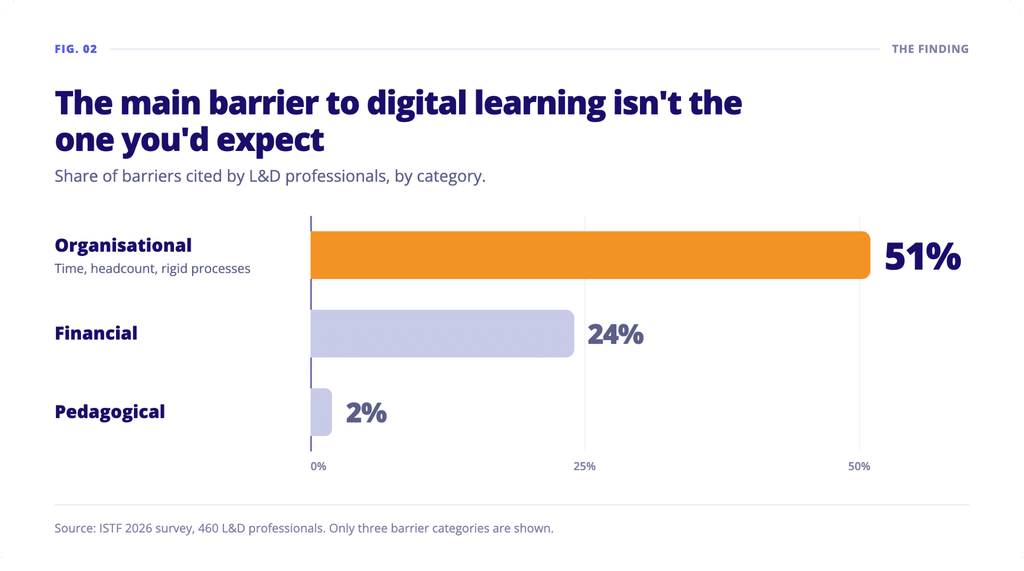
Yet according to the 2026 ISTF survey of 460 training professionals, 51% of barriers to digital learning are organizational (time, headcount, rigid processes), 24% financial and only 2% pedagogical. OPPBTP’s case illustrates this reality: the barrier is first of all a question of how time is organized.
Why Beekast
OPPBTP discovered Beekast in 2018 at a trade show. The initial use came down to one feature: anonymous barometers. Thanks to Beekast’s anonymous mode, participants speak more freely, which gives a realistic assessment of prevention levels and a better identification of risks.
For Yannick Gervais, this anonymity is the starting point for everything:
“Beekast lets us create these barometers anonymously, and that’s a huge advantage for knowing where we stand on prevention.”
The tool then became part of daily work: general and specialized training, webinars, internal meetings, targeted campaigns and the national seminar. The rollout relied on support from the Beekast team, webinars and internal resources, which built a network of ambassadors in every agency.
Today, the question has changed. OPPBTP no longer asks only how to collect sincere answers, but how to design faster, guarantee that what is delivered is what was planned, and analyze results without spending days on it. Yannick Gervais sums it up: the barrier is the time lost designing modules.
OPPBTP’s best practices
1. Design once, lock it, deploy everywhere
OPPBTP builds a reference module in a master session, then deploys locked clone sessions to external trainers, regional agencies, relay trainers and field facilitators. Nobody can change the activities: what is delivered is what was planned. A correction is made only once, in the reference module, and everyone benefits from the new version. It is also a quality argument, as Yannick Gervais explains: “With the master session, what is delivered is what was planned. We ensure certification, we ensure data quality, and we keep control of it.”
Tip: don’t lock everything. Leave the trainer in charge of facilitation, pacing and discussion with the room. That is what brings the module to life.

2. Plan for results from the design stage: the four-module skeleton
Every training course follows the same skeleton, adapted to the topic.
- Entry assessment, named, to measure the starting level.
- Activities during the training, anonymous, so everyone speaks honestly.
- Exit assessment, named, to measure progress on the same questions.
- Hot feedback survey, to collect satisfaction.
Named responses are used to assess learning, especially when a course has to be validated. Anonymity gives more honest feedback. This skeleton amounts to about four modules per course, or about 500 modules a year for 100 to 120 courses.

3. Consolidate the results of a national campaign in one click
A national campaign means about fifty sessions spread across France whose answers must be brought together. Yannick Gervais sums up the difference: “Before, we had to pull together all the Excel results, compile everything, process everything, check everything. We spent three days on it for a national campaign. Today, with the master session, we get our results by activity and even as a word cloud.” The master session gathers answers from across France, and even by region if needed, without building a single table by hand.

In the field, facilitation changes too. The risk hunt used to be done on paper. Today, a job site photo appears on screen, everyone spots risks from their phone with the Pin on image activity, and the correction is done together from the room’s answers.

4. Use AI as an assistant, not a replacement
Pollen Create, Beekast’s AI assistant, changes how modules are designed, not the trainer’s role. For Yannick Gervais, the rule is clear: “AI doesn’t design in place of the trainer. It helps them design. The human must remain in charge.” He tested it with a one-sentence prompt, a 10-minute cybersecurity self-assessment, and the result surprised him: two minutes later, he had “a module in hand, with questions we would never have thought of.” A first draft is only that, though: the trainer reviews, adjusts and decides what gets delivered. “The trainer stays free,” Yannick Gervais insists. “They are the guarantor of their module: it’s up to them to make sure what we produce meets their expectations.”
His prompt formula: format, duration, topic, number of participants and audience. For example: a 10-minute cybersecurity self-assessment for 25 site managers.

5. Reinvest the time saved in updating modules
The freed-up time isn’t used to produce more activities, but to maintain modules. Yannick Gervais explains why: “A module that isn’t maintained is a risk with respect to the client.” OPPBTP therefore puts as many hours as possible back into checking and updating its modules.
6. Use the tool beyond training
OPPBTP also uses Beekast at its annual seminar, with a word cloud in plenary sessions, in internal meetings and in internal surveys. For Yannick Gervais, this versatility matters at purchase time: “A tool is easier to sell when you can say: we could use it for internal meetings, for our seminars, for internal surveys.” A multi-purpose tool is easier to defend to buyers, and its cost is spread across several budgets.

Results and ROI
Yannick Gervais warns that ROI is always something complex and a bit individual. OPPBTP therefore gives a conservative estimate, based on a gain of 30 minutes per module, that counts neither campaign analysis nor the other uses of the tool.
| Step | Calculation | OPPBTP result |
| Modules designed per year | OPPBTP data | about 500 (100 to 120 training courses) |
| Minutes saved per module | OPPBTP estimate | 30 |
| Hours freed up per year | 500 × 30 min ÷ 60 | 250 h |
| Fully loaded hourly cost | assumption | about €100 |
| Annual gain | 250 h × €100 | about €25,000 |
| Designers | OPPBTP data | about 45 |
| Gain per designer | €25,000 ÷ 45 | about €550 |
This gain is time given back, not cash savings: OPPBTP reinvests it in updating its modules.

Count designers, not sessions
Yannick Gervais’s advice for making the case internally: the number of sessions varies from year to year, the number of people who design varies much less. With 45 designers, the calculation gives about €25,000. An organization with 450 designers, at the same pace, gets about €250,000. That is a linear extrapolation, not a measurement.
What the calculation doesn’t count
- National campaign analysis: up to 3 days saved per campaign. For a master-session-type activity, analysis took around two person-days, and up to three days with several activity types.
- A first draft of a module in about 2 minutes with Pollen Create.
- Other uses: annual seminar, internal meetings, internal surveys.
- Quality: the same module for every trainer, internal or external, with no version drifting from one region to another.
What OPPBTP has streamlined
- Design time, on the trainer’s side.
- Data compilation, with results flowing up into the master session.
- Analysis time for a national survey.